
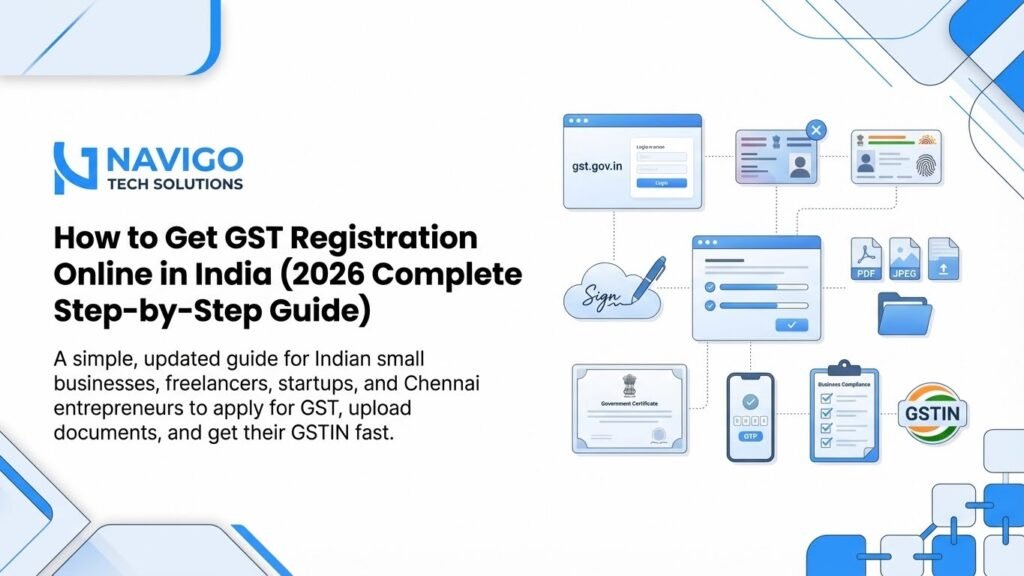

Every day, people search for how to get GST registration, the required documents, and the fees involved. This guide is especially for new business owners in India and Chennai.
What Is GST Registration?
GST stands for Goods and Services Tax. GST registration is the legal process that allows your business to:
- Collect tax from customers
- Issue GST invoices
- Claim input tax credit
- Sell on Amazon, Flipkart, Meesho
- Work with corporate clients
- Run Google Ads and Meta Ads smoothly
Simply put, GST gives your business tax identity + growth eligibility. You can apply via the official Goods & Services Tax Network (GSTN) portal at gst.gov.in.
Who Is Eligible for GST Registration in India?
You must apply for GST registration if:
- Your annual turnover crosses ₹20 lakh for services
- Your product turnover crosses ₹40 lakh
- You sell on ecommerce platforms
- You do inter-state business
- You run paid ads for lead generation
- You export services or goods
Most digital agencies, freelancers, ecommerce sellers, consultants, and startups in Chennai already require GST from day one.
GST Registration Turnover Limits
| Business Type | GST Mandatory At |
|---|---|
| Service Business | ₹20 Lakh |
| Product Business | ₹40 Lakh |
| Ecommerce Sellers | No minimum limit |
| Inter-state Sellers | Mandatory |
| Exporters | Mandatory |
Benefits of GST Registration for Small Businesses
After you get your GST number, your business becomes:
- Legally compliant
- Eligible for corporate projects
- Eligible for government tenders
- Approved for Amazon and Flipkart
- Eligible for business loans
- Eligible for input tax credit
- Trusted by vendors and clients
GST is not just tax. It is your business growth passport.
GST Registration Documents Required in India
To apply on the official portal, you need:
- PAN card
- Aadhaar card
- Passport-size photo
- Business address proof
- Bank account proof
- Electricity bill or rental agreement
These GST registration documents are required for individuals, small businesses, proprietorships, and private limited companies.
How to Get GST Registration Online – Step-by-Step (2026 Process)
Step 1: Visit the official GST portal at gst.gov.in.
Step 2: On the homepage, click Services → Registration → New Registration.
Step 3: Fill Part-A: PAN, email, mobile, business type. Complete OTP verification.
Step 4: Using the Temporary Reference Number (TRN), log back in and complete Part-B with business address, bank details, and upload proofs.
Step 5: Verify via Aadhaar OTP or Digital Signature. Upon approval, you receive your GSTIN. Typical time: 3 to 7 working days.
New GST Registration Fees in India (2026)
Many people ask about new GST registration fees. Here’s the truth:
- Government fee: ₹0
- GST registration via official portal: Free
If you hire a consultant, expect ₹1,500–₹4,000 one-time for paperwork or convenience. If someone quotes more, ask for justification.
How Many Days Does It Take to Get GST Registration?
- Standard approval time: 3 to 7 working days
- If documents are correct and Aadhaar authentication succeeds, many get GST within a few days
- Delays occur only due to mismatched documents or address verification issues
Where to Apply for GST Registration?
Apply only through the official portal: gst.gov.in. Avoid third-party or “easy-signup” websites — they may charge extra and create compliance risk.
GST Registration for Different Business Types
Proprietorship
Use owner PAN and Aadhaar + bank details.
Partnership Firm
Use firm PAN + partner Aadhaar + partnership deed + bank details.
Private Limited Company
Use Company PAN + director Aadhaar + certificate of incorporation + registered office proof.
All types are supported via GST Portal.
GST vs MSME Registration — Why Many Do Both
Many confuse GST with Udyam Registration (for MSME benefits). They serve different purposes:
| GST | Udyam / MSME Registration |
|---|---|
| Tax registration & compliance | Business recognition + subsidies |
| Mandatory for high turnover or ecommerce | Optional, but highly beneficial for loans & tenders |
| Free registration via GSTN | Free via Udyam portal |
👉 If you also want MSME benefits, refer to the official Udyam portal at udyamregistration.gov.in.
What to Do After You Get Your GST Number
Once GSTIN is active:
- Issue proper GST invoices to clients
- Add GST number on your website and billing system
- Link GST with bank + accounting
- Start digital marketing/ads legally
For growth, consider adding MSME registration, Google My Business listing and a professional website.
GST Return Filing Basics (What Comes Next)
After GST registration:
- File GSTR-1 (sales) and GSTR-3B (tax payment) monthly or quarterly
- Even if business is zero, filing is mandatory
- Missing filing leads to penalties and interest
GST Registration for Chennai & Tamil Nadu Businesses
Whether you are based in Chennai (Arumbakkam, Anna Nagar, T Nagar, Tambaram, Velachery, etc.) or Coimbatore, Madurai, Trichy or any Tamil Nadu city, the entire process is online, no physical visit needed — just Aadhaar + PAN + address proof + bank details.
Final Word on GST Registration
GST isn’t just a tax number — it’s your legal identity, a pass to corporate clients, e-commerce, loans, and a growth-enabler for any serious business. Skip GST and you limit your business potential.
Need help launching or scaling?
We’ve got you. Contact NaviGo Tech Solutions — your one-stop launchroom.