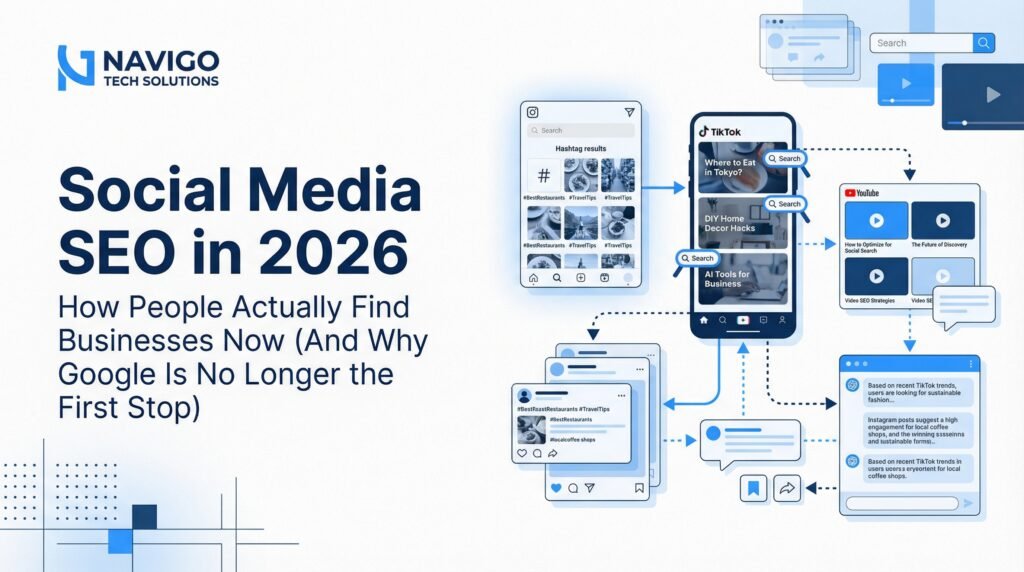

Right now, someone is actively looking for what you sell. But discovery no longer starts in a browser; it starts inside the app drawers of billions of users. This is not a trend—it’s the new reality of digital commerce.
This blog breaks down exactly how social media SEO works in 2026, how people search on social platforms, and what you must change immediately to outrank your competitors.
- Social platforms are no longer just content feeds; they are search engines with feeds.
- Discovery happens in the feed before the search bar ever gets touched.
- Search intent has moved from “keywords” to “spoken problems.”
- On-platform actions (saves/shares) are now stronger ranking signals than external clicks.
- Social Platforms Are the New Search Engines
- Where to Focus First (Platform Priority)
- Discovery Starts in the Feed, Not the Search Bar
- How People Really Search on Social Platforms
- Structure Is What Makes Content Indexable
- On-Platform Actions Are Now Ranking Signals
- Social Content Feeds AI Search Engines Too
- What to Measure Instead of Vanity Metrics
- Final Take: Search Expanded
Social Platforms Are the New Search Engines
SEO no longer starts with a browser. It starts inside apps. Instagram and YouTube handle billions of searches daily, and TikTok has officially overtaken Google for Gen Z product discovery and “how-to” queries.
People go to video first because they want to see, not read. If your brand is not optimized for social search, your competitors are capturing demand long before users ever think of typing into Google.
Where to Focus First (Platform Priority)
Not every platform behaves the same way for search. Effort needs direction:
- Daily High Intent: Instagram, YouTube
- Weekly Discovery: TikTok, Facebook
- Monthly Research: LinkedIn
B2C brands should prioritize Instagram and YouTube first. B2B brands should focus on YouTube and LinkedIn with consistency. Match your choice to how often your audience searches, not where you personally like posting.
Discovery Starts in the Feed, Not the Search Bar
In 2026, people discover solutions before they realize they need them. Algorithms surface answers (Tutorials, Demos, Comparisons) inside the feed. By the time someone eventually searches intentionally, their decision is already influenced or made.
You do not win SEO in the search bar. You win it by showing up inside the feed with the right content. If your video doesn’t deliver clarity in the first few seconds, the algorithm moves on, and your audience never sees you.
How People Really Search on Social Platforms
People no longer search with keywords; they search with full questions and real situations. Instead of “dry skin,” they search for “How do I fix dry skin in winter?”
Platforms now index captions, on-screen text, spoken words, and subtitles. If your content doesn’t use the same language people type, it doesn’t get indexed. Generic content like “Transform your skin with this routine” loses to search-optimized content like “How to fix dry skin in winter: 3 dermatologist-approved tips.”
Structure Is What Makes Content Indexable
Algorithms cannot rank what they cannot understand. To be indexable, your content must include:
- Clear headline-style hooks in on-screen text.
- Subtitles so spoken words can be indexed.
- Captions written in natural language with long-tail phrases.
- Clear topic focus that matches user intent.
On-Platform Actions Are Now Ranking Signals
Social media is no longer just top of funnel. Platforms now reward what happens without leaving the app. If users leave the platform, reach drops. If they stay and act, reach increases.
Stop forcing clicks and start driving actions: Use native product tagging, replace external landing pages with platform lead forms, and treat DMs as your primary conversion channel. Learn more in our Social Media Marketing Services.
Social Content Feeds AI Search Engines Too
AI systems like ChatGPT and Perplexity pull heavily from social discussions and community content. When someone asks an AI for a recommendation, it often references YouTube videos or social threads. Your social content influences buying decisions even when there is no click. Traffic drops don’t mean demand drops—they mean discovery moved upstream.
What to Measure Instead of Vanity Metrics
Views and likes are not enough. Focus on:
- Search-based reach: Check analytics for reach coming directly from search.
- Saves and shares: These signal long-term value and problem-solving relevance.
- Brand mentions in AI: Track where your brand appears in community threads and AI responses.
Final Take: Search Expanded
Buying no longer happens in funnels; it happens across ecosystems. The brands that win in 2026 are not the ones with the best landing pages—they are the ones that show up everywhere people search and answer questions clearly, early, and consistently. If you are still optimizing only for Google, you are late.