Google Automations Are Here: What Indian Businesses Must Know in 2026
Google’s AI-powered automations are no longer a future promise — they are live, they are changing how ads run, how content ranks, and how customers find businesses right now. If you run a business in India and you are still managing your marketing the old way, you are already behind. This guide explains exactly what has changed, why it matters for Indian entrepreneurs, and what practical steps you can take today.
This guide covers:
- What Google automations actually are and how they work in plain language
- Why 2026 is a turning point for Indian small businesses and marketing teams
- A step-by-step plan to adapt your business to Google’s new automation landscape
- The most common mistakes Indian business owners make with automation — and how to avoid them
Read on to get a clear, no-fluff picture of where things stand and what you should do about it.
- How Google’s Gemini-powered agentic automation works and what it can do for your business
- Why Indian businesses that ignore these changes will lose ground to competitors who embrace them
- Concrete steps to start using Google automations without a big technical team or budget
- Which automation tools and Google features deserve your attention in 2026
What Are Google Automations — A Plain Explanation
Google automations refer to a set of AI-powered tools and systems that Google has built into its advertising, search, and productivity platforms. These tools handle tasks that previously required constant human input — things like choosing which ad to show to which person, adjusting bids in real time, writing ad copy variations, or deciding when and where your content appears. The idea is that the machine learns from data and makes decisions faster and more accurately than any human team could.
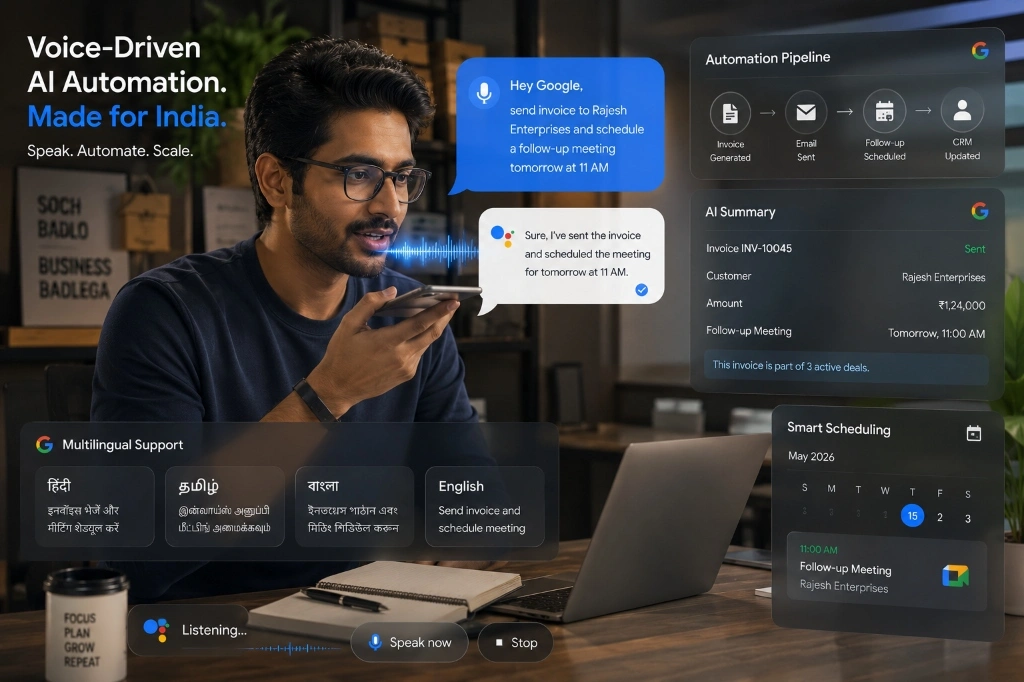
The biggest development in early 2026 is what Google calls the agentic era of Gemini. According to Business Today, Gemini can now automate multi-step tasks across Android apps — meaning it does not just answer questions but actually completes workflows on your behalf. Think of it as a digital assistant that can browse, fill forms, send messages, and trigger actions across different apps without you clicking anything. For a business owner, this is the equivalent of having a tireless junior employee who never sleeps and never makes the same mistake twice.
On the advertising side, Google’s Performance Max campaigns use machine learning to run ads across Search, YouTube, Gmail, Display, Maps, and Discover all from a single campaign. You provide the creative assets — images, headlines, descriptions, and a budget — and Google’s system does the rest. It tests combinations, learns what works, and shifts spend towards the placements and audiences that convert best. For a textile shop in Coimbatore or a coaching centre in Anna Nagar, this means your Rs 10,000 monthly ad budget works significantly harder than it did three years ago.
Google has also integrated automation deeply into Google Search itself through AI Overviews. When someone searches for a service you offer, Google may now show an AI-generated summary at the top of the page before any organic links. This changes how traffic reaches your website and makes your content strategy more important than ever before.
Why This Matters Specifically for Indian Businesses in 2026
The Indian digital market is growing at a speed that rewards automation
India has over 900 million internet users and that number keeps climbing. The volume of search queries, ad impressions, and online transactions happening every second across Tier 1 and Tier 2 cities is enormous. No small business owner can manually manage marketing at this scale. Google automations effectively level the playing field, giving a Chennai-based boutique the same algorithmic muscle that a large national retail chain has. Think with Google’s APAC data from 2025 confirmed that businesses using marketing automation with AI and machine learning were seeing measurably better campaign efficiency and customer targeting results across the Asia-Pacific region — and India is at the centre of that growth.
Reliance and Google have already partnered to bring AI deeper into India
The launch of Reliance Intelligence in partnership with Google and Meta signals that AI-powered automation is not just a global trend being observed from a distance. It is being built into the Indian market infrastructure. This means local businesses will encounter more AI-driven customer interactions, more automated ad environments, and more AI-assisted commerce platforms. Being unprepared for this shift is not neutral — it is a competitive disadvantage that will compound over time.
Hiring alone will not solve the problem
A Times of India report from January 2026 noted that Indian companies are cutting volume hiring and going selective on STEM talent. Businesses cannot simply hire their way out of the automation challenge. The smarter path is to equip existing teams with the right AI tools and processes. Google has even released free AI courses with certificates — reported by NDTV in December 2025 — which means your marketing team can upskill without significant cost. The barrier to getting started is genuinely low.
Agentic commerce is changing how customers buy
McKinsey published research in late 2025 on what they called the agentic commerce opportunity — the idea that AI agents will increasingly make purchasing decisions on behalf of consumers, comparing products, checking availability, and completing transactions. For Indian e-commerce businesses and service providers, this means your business needs to be visible and structured in a way that AI agents can read, evaluate, and recommend. A messy website with no clear pricing or structured data will simply be skipped.
How to Start Using Google Automations — Step by Step
- Step 1 — Audit your current Google presence. Before you touch any automation tool, check your Google Business Profile, your Google Ads account (if you have one), and your website’s performance in Google Search Console. You need a clean foundation. Fix any errors, update your business information, and make sure your website loads quickly on mobile. Automation amplifies what is already there — if the base is broken, automated tools will amplify the wrong signals.
- Step 2 — Set up or review your Google Business Profile for automation readiness. Google’s local automation features rely heavily on your Business Profile. Add your products or services, upload recent photos, respond to reviews, and enable messaging. Google’s systems use this data when deciding which businesses to surface in local searches, Maps, and AI-generated responses. A complete profile is not optional — it is the entry ticket to appearing in automated local recommendations.
- Step 3 — Switch to Performance Max if you run Google Ads. If you are still running individual keyword campaigns with manual bidding, it is time to test Performance Max. Start with a modest budget — even Rs 15,000 per month — and feed the campaign high-quality images, at least five headline variations, and a clear conversion goal such as phone calls or form fills. Let it run for at least 30 days before judging results, because the algorithm needs data to learn from.
- Step 4 — Use Google’s AI-powered tools inside Google Workspace. If your team uses Gmail, Google Docs, or Google Sheets, Gemini is already available to assist with drafting emails, summarising documents, and building reports. Encourage your team to use these features for everyday tasks. This is the easiest and fastest way to introduce automation into your operations without any technical setup.
- Step 5 — Structure your website content for AI Overviews. Google’s AI Overviews pull information from websites that answer questions clearly and concisely. Write FAQ-style content on your website that directly answers what your customers search for. Use structured headings, short paragraphs, and clear factual statements. This is not just good SEO — it is how you get referenced when Google’s AI summarises search results at the top of the page.
- Step 6 — Monitor, learn, and iterate. Google provides detailed reports on how its automated campaigns and tools are performing. Review these weekly. Look at which assets in your Performance Max campaign are getting the best ratings, which audience segments are converting, and where your impressions are showing up. Use this data to improve your creative assets and refine your goals. Automation does the heavy lifting, but human judgement still decides the direction.
Common Mistakes Indian Businesses Make with Google Automations
Mistake 1 — Handing over full control without setting clear goals
Many business owners hear “automation” and assume they can set it up once and walk away. That is not how it works. Google’s automated systems need clear conversion goals to optimise towards. If you do not tell the system what a successful outcome looks like — a phone call, a form submission, a purchase — it will optimise for something vague like clicks or impressions, which may not translate into revenue. Always define your conversion action before switching on any automated campaign. This is one of the most costly errors we see Indian businesses make with Google Ads specifically.
Mistake 2 — Ignoring the quality of input assets
Google’s automation is only as good as what you feed it. If your ad images are blurry, your headlines are generic, and your landing page is slow to load, the algorithm will not produce good results no matter how sophisticated it is. Invest time in creating strong creative assets before expecting automation to deliver. A well-written ad paired with a fast, focused landing page will always outperform a lazy automation setup. If content creation feels overwhelming, our content creation services can help you build the right assets from scratch.
Mistake 3 — Neglecting organic search while focusing only on paid automation
Google automations in paid advertising are valuable, but they should not replace your organic search strategy. AI Overviews, local search, and structured content all drive free, high-intent traffic that does not disappear when your ad budget runs out. Many Indian business owners pour money into Performance Max while their website has thin content, slow load times, and no local SEO foundation. The smarter approach is to build both in parallel. For a thorough look at how to rank organically, our Google AI updates 2026 guide covers how Google’s latest changes affect your visibility in search results.
Mistake 4 — Skipping the learning period and making premature changes
Google’s automated campaigns go through a learning phase — typically two to four weeks — during which the algorithm is gathering data and testing combinations. Many business owners panic when they see inconsistent results in the first week and start changing budgets, pausing campaigns, or switching objectives. Every change you make resets the learning phase. Commit to your initial setup for at least a month, review the data with patience, and then make one change at a time so you can clearly see what is working.
Mistake 5 — Not linking automation with a broader AI marketing strategy
Google automations do not exist in isolation. They work best when connected to a broader strategy that includes AI-driven social media, smart content pipelines, and automated customer follow-ups. Businesses that treat each channel separately end up with fragmented data and inconsistent messaging. An integrated approach, where your Google automation feeds into your CRM and your social media efforts reinforce your search presence, produces compounding results. Our AI ads and automation services are designed to connect these pieces into one coherent system for Indian businesses.
Key Google Automation Features Compared — What to Use and When
Google has rolled out several automation tools across its ecosystem, and not all of them are relevant to every business. The table below gives you a practical overview of the main features, who they are best suited for, and what level of technical effort is involved. Use this as a reference when deciding where to start.
| Google Automation Feature | Best For | What It Does | Effort to Set Up |
|---|---|---|---|
| Performance Max Campaigns | Businesses running paid ads with a clear conversion goal | Automatically runs ads across Search, YouTube, Maps, Gmail, and Display from one campaign | Medium — needs good creative assets and conversion tracking |
| Smart Bidding (Target CPA / ROAS) | Businesses with at least 30-50 conversions per month tracked | Adjusts bids in real time using machine learning to hit your cost or return target | Low — enable within existing campaigns once conversion tracking is set |
| Google Business Profile Automation | Local service businesses, retailers, restaurants | Surfaces your business in local AI-driven recommendations, Maps, and voice search | Low — complete your profile thoroughly and keep it updated |
| Gemini in Google Workspace | Any business using Gmail, Docs, Sheets, or Meet | Drafts emails, summarises documents, builds reports, and suggests next steps | Very Low — built-in, just needs to be enabled for your account |
| AI Overviews (Search Generative Experience) | Content-driven businesses, service providers, educators | Pulls answers from well-structured websites to show at the top of search results | Medium — requires structured, high-quality content on your website |
| Demand Gen Campaigns | E-commerce brands and businesses targeting younger audiences | Uses AI to place visual ads on YouTube Shorts, Gmail, and Discover to drive awareness and interest | Medium — needs strong visuals and audience targeting inputs |
Choosing the right combination of these features depends entirely on your business type, budget, and current digital maturity. If you are just starting out, the Google Business Profile and Gemini in Workspace are zero-cost entry points. If you are ready to scale your paid marketing, Performance Max and Smart Bidding are worth serious investment. For businesses looking at a structured path to getting all of this right, our AI strategy consulting service helps Indian businesses build a phased automation roadmap that fits their goals and resources.
Frequently Asked Questions
Do I need a big budget to use Google automations for my small business in India?
Will Google automations replace my marketing team or agency?
How do Google AI Overviews affect my website’s organic traffic?
How long does it take to see results from Google’s automated ad campaigns?
Ready to put Google automations to work for your business? Let NaviGo Tech Solutions build you a strategy that saves time, reduces wasted ad spend, and grows your revenue — starting this week.