- Entity maps help Google understand your business context, not just isolated keywords
- A well-structured entity map can improve rankings for all related searches
- It works by connecting topics, products, and services in a logical web
- You can build one step by step without hiring a big agency
What Is an Entity Map Structure?
An entity map structure is a way of organising content on your website so that Google clearly understands the relationships between different topics, products, and services you offer. Instead of writing blog posts and product pages in isolation, you link them together in a logical way that mirrors how your business operates.
For example, imagine you run a dental clinic in Chennai. You want to rank for services like teeth whitening, root canals, and dental implants. Without an entity map, each of those pages would be treated as separate pieces of content. With an entity map, you create a central page about your clinic that links to each service page. Those service pages then link back to the main page and to each other through related content such as blog posts about dental care tips or patient testimonials.
Google uses these connections to understand that your clinic is the entity, and all the services and topics are related to it. This helps your domain become more authoritative for all the searches in that area. It moves your site from being a collection of separate pages to being a trusted source on dental care in your area.
This idea is not new but has become more important because Google now uses artificial intelligence to interpret search queries. Instead of just matching keywords, Google looks at the meaning behind the search. An entity map helps Google see the context of your business, which is especially useful for local searches in India where people use different terms for the same service, like dental implants or artificial teeth.
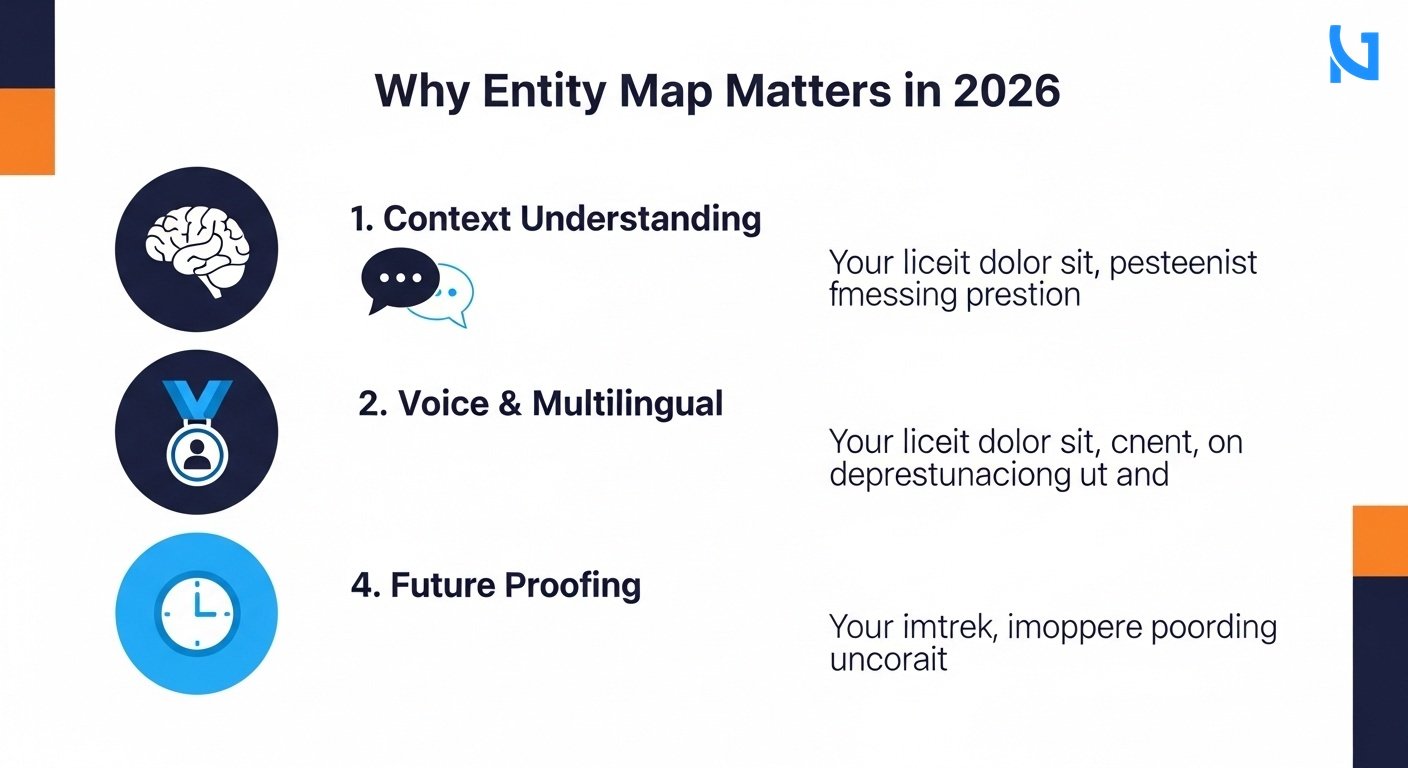
Why Entity Map Structure Matters for Indian Businesses in 2026
Google’s AI Understands Context, Not Just Keywords
Google’s latest algorithms, including the models behind RankBrain and BERT, focus on understanding the meaning of a query. When someone searches for “best restaurant in T Nagar,” Google does not just look for pages with those exact words. It looks for pages about restaurants in T Nagar that have signals of being highly rated and relevant. An entity map on your restaurant website helps Google confirm that your page is the right result because it clearly connects to other related entities like your menu, location, and reviews.
Helps With Voice and Multilingual Searches
Indian users are increasingly searching using voice or mixing languages like Hindi and English. A person might say, “Chennai me sabse achha dentist kaun hai?” Without an entity map, your dental clinic might not rank for this query because the words do not match your page. But if Google understands your site as the entity for a dental clinic in Chennai, it can match the intent of that query even if the phrasing is loose. This is a huge advantage in a multilingual market.
Builds Authority Over Time
When you structure your site around entities, you naturally create a web of high-quality content. Every new article or service page adds to the authority of your main entity. Over time, Google starts to trust your site as a go-to source for that topic. This makes it easier to rank for new, related terms without starting from zero. For small businesses in India with limited content budgets, this compounding effect is very valuable.
How to Build an Entity Map Structure for Your Website
Building an entity map does not require technical coding skills. It is about logically organising your content. Follow these steps for your business website.
- Step 1: Identify your main entity. This is the core of your business. For most businesses, it is your brand or company name. For a service provider, it could be the main category of services. Write down the single most important thing your business is about.
- Step 2: List all sub-entities. These are the specific products, services, locations, and customer groups you serve. For a salon, sub-entities might include haircuts, bridal makeup, skin treatments, and home service. Write each one as a distinct idea.
- Step 3: Create a hub page for the main entity. Your homepage or a dedicated about page should clearly state what you do and link to all your sub-entities. This is the central page that Google uses to confirm your identity.
- Step 4: Create pillar pages for each sub-entity. A pillar page is a comprehensive page that covers one sub-entity in depth. For example, a page on bridal makeup should describe the service, include images, and answer common questions.
- Step 5: Write cluster content that links back. Write blog posts or service pages that are related to each pillar page. For bridal makeup, you could write about different types of bridal looks, or how to prepare your skin before makeup. Every such post should link to your bridal makeup pillar page and back to your main entity page.
- Step 6: Use clear internal links. Every page on your site should have at least one link to another related page. Avoid orphan pages that have no links pointing to them. Internal links are the roads of your entity map.
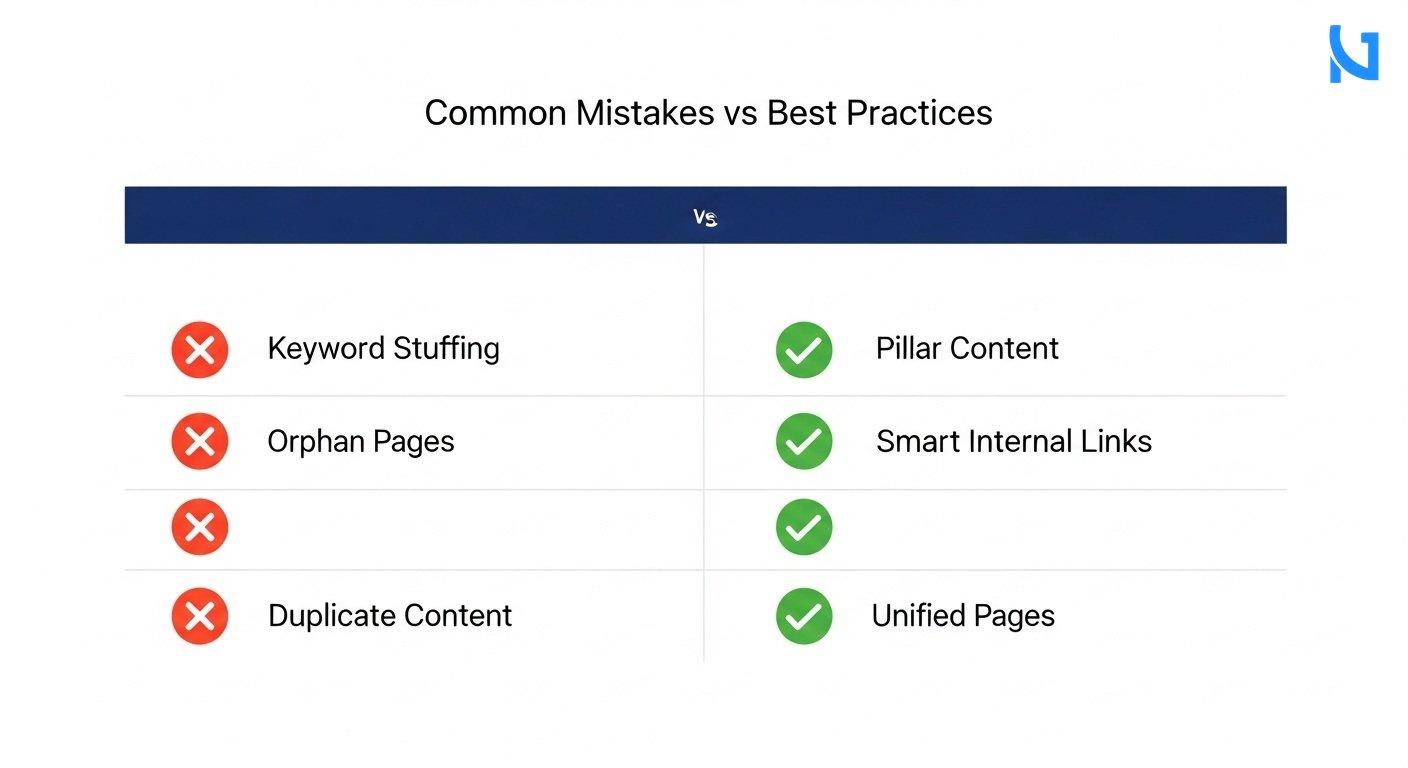
Common Mistakes Indian Businesses Make With Entity SEO
Mistake 1: Focusing Only on Keywords
Many business owners still stuff their pages with keywords like “best dentist in Chennai” without connecting that page to other related content. This makes Google see the page as a standalone attempt to rank, not as a trusted resource. Instead of writing five separate pages targeting similar keywords, create one strong pillar page and link to supporting blog posts. For example, our Local SEO guide for Chennai explains how to coordinate your pages for better results.
Mistake 2: Ignoring Internal Linking
Some websites have a blog and a services section that never link to each other. This breaks the entity map. Every blog post about a service should link to the relevant service page. Every service page should link to relevant blog posts. Internal links are free and powerful.
Mistake 3: Having Duplicate or Thin Content
Creating many shallow pages just to target different keyword variations confuses Google. For example, a page on “affordable dental clinic Chennai” and another on “cheap dental clinic Chennai” with the same content does not help. Instead, write a single detailed page that covers affordability, and link to it from related posts. This strengthens your main entity.
Entity Map vs Traditional Keyword SEO: A Comparison
To understand the shift, look at the table below. It shows how entity map structure differs from the older approach of targeting individual keywords.
| Aspect | Traditional Keyword SEO | Entity Map Structure | What Works Better in 2026 |
|---|---|---|---|
| Focus | Individual keywords | Topics and relationships | Entity map |
| Content creation | Many thin pages | Fewer, deeper pillar pages | Entity map |
| Internal linking | Minimal or random | Intentional and structured | Entity map |
| Google understanding | Looks at keywords | Understands context | Entity map |
| Maintenance | Adds more keywords | Adds supporting content | Entity map |
| Long term results | May drop when trends change | Builds lasting authority | Entity map |
As you can see, entity map structure is the modern way to do SEO. It requires more planning at the start but pays off with stable, long-term rankings. If you need help setting up your entity map, our SEO optimization service can guide you through the process from start to finish.
Not sure which tool fits your business?
Our team at NaviGo Tech Solutions will set it up for you — free 30-minute strategy call.