
- How to define and measure AI search presence for your brand
- Which metrics matter most: citation rate, source type, sentiment, and volume
- Five practical steps to start tracking your AI visibility today
- Three critical mistakes Indian businesses make and how to fix them
- A detailed comparison of tracking tools to suit every budget
What Is AI Search Presence and Why Indian Businesses Must Track It
AI search presence is the measure of how often your business is cited as a source in answers generated by AI platforms. When a customer asks ChatGPT for “the best digital marketing agency in Chennai,” the model reads through available content and selects sources to include in its reply. If your website or content appears in that answer, you have AI search presence.
This is different from traditional SEO where you aim to rank in a list of blue links. AI search engines do not show a ranked list. They produce a single, synthesised answer. Only a few brands get cited in that answer. The rest are invisible. For Indian businesses, this shift is urgent because Google still holds over 95% market share in India, but AI platforms like ChatGPT (15-20 million monthly active users in India) and Perplexity (3-5 million) are growing rapidly.
Tracking your AI search presence lets you answer three questions. Are you being cited at all? Which AI engines cite you? What context do they use? Without this data, you cannot improve your strategy. The Indian businesses guide to tracking presence in AI search gives you the framework to start monitoring today.
Consider this: 80% of citations by ChatGPT, Perplexity, and Microsoft Copilot do not rank in Google’s top 100 results. This means your traditional SEO reports tell you nothing about your AI visibility. You need a separate tracking system.
Key Metrics to Track Your AI Search Visibility
To track your presence effectively, you need to measure the right numbers. Here are the four most important metrics for Indian businesses.
Citation Rate
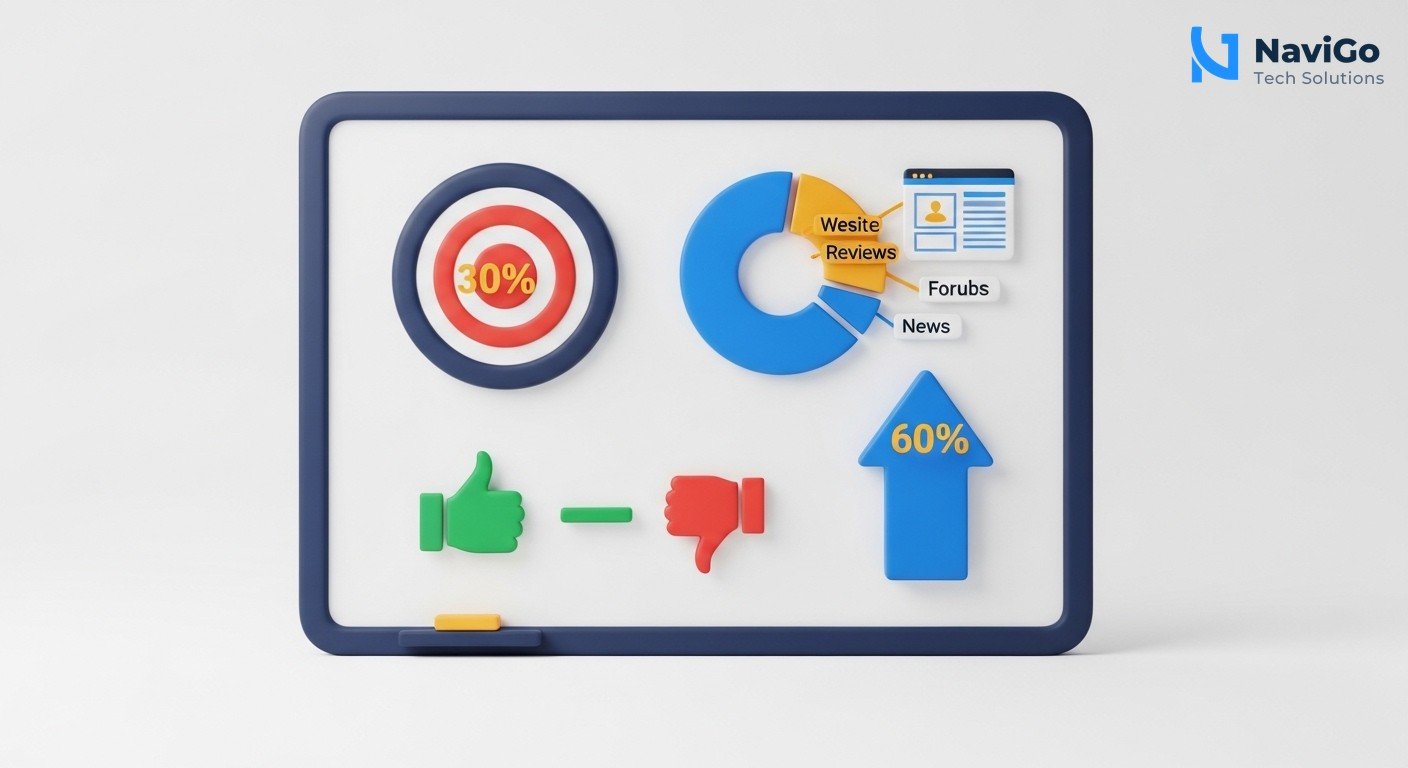
Your citation rate is the percentage of AI-generated answers that include your brand when relevant queries are asked. For example, if you search for “affordable web development in Chennai” across three AI engines and your brand appears in one answer, your citation rate is 33%. A healthy rate depends on your industry, but a good starting target is 20% to 30% for your top 10 keyword queries.
Source Type Distribution
AI engines cite brands from different source types. These include your own website, third-party review platforms, Wikipedia, forums like Reddit or Quora, and news publications. Brands are 6.5 times more likely to be cited through third-party sources than through their own domains. Tracking where citations come from helps you build authority outside your website.
Sentiment and Context
Not all citations are equal. A positive mention that recommends your service is far more valuable than a neutral listing. When tracking, note whether the AI answer positions your brand as a top pick, an alternative, or just a passing reference. Tools like Semrush and AIVO can help assess sentiment automatically.
Query Volume Growth
Track the number of AI queries that trigger a mention of your brand. If this number grows month over month, your AI search presence is strengthening. Vernacular AI queries in India are growing 60-80% year over year, so brands with content in Hindi and regional languages see faster volume growth.
Step-by-Step Guide to Tracking Your Brand in AI Search
Follow these five steps to start tracking your AI search presence manually. Later, you can invest in paid tools for automation.
- Step 1. List your top 10 AI-relevant queries. Think about questions your customers ask. Start with “best [your service] in [your city]” and “[your service] provider India.” Include Hindi and regional language versions if you serve those audiences.
- Step 2. Query each AI engine manually. Use ChatGPT, Google Gemini, Perplexity, and Microsoft Copilot. Ask each query in a new session. Take screenshots of every answer. This gives you a baseline. Repeat this every week.
- Step 3. Record citations in a spreadsheet. Create columns for query, AI engine, date, and whether your brand was cited. Add columns for source type (your website, third party, review site) and sentiment (positive, neutral, negative). Track which competitors are cited more often.
- Step 4. Check third-party citation sources. AI engines trust reviews and mentions more than your own content. Monitor platforms like Trustpilot, G2, Justdial, IndiaMart, and Google Business Profile. Brands active on these are cited 3 times more often.
- Step 5. Use a free tool to automate some tracking. Set up Google Alerts for your brand name plus terms like “best” and “top.” Monitor Reddit and Quora for discussions about your category. These alerts give you early signals without spending money. For deeper data, consider moving to paid tools like Semrush or AIVO.
This manual method works well for small businesses with limited budgets. Once you see consistent citations, you can invest in AI search tracking tools that provide automated reports on all AI engines at once.
Common Mistakes That Kill Your AI Search Presence
Indian businesses often make these three mistakes when trying to get cited in AI answers. Avoid them to protect your visibility.
Mistake 1: Relying Only on Google Rankings
Many business owners check only their Google search position and assume they are visible. But 80% of AI citations come from sources that do not rank in Google’s top 100. Your website may have excellent Google rankings yet be completely absent from ChatGPT answers. Focus on AI-specific tracking, not just traditional SEO. Our guide on Google AI Updates 2026 explains how the search landscape is splitting.
Mistake 2: Ignoring Your Google Business Profile
Your Google Business Profile is no longer a local SEO tactic. It is a foundational GEO asset. AI engines use it as a key source for local recommendations. If your profile is incomplete, has outdated hours, or lacks photos, AI systems may skip you in favour of a competitor with a richer profile. Update your profile with accurate details, recent photos, and consistent responses to reviews.
Mistake 3: Neglecting Third-Party Citations
AI engines do not trust what you say about yourself. They trust what others say about you. A single article on a reputable Indian publication mentioning your business can generate citations across multiple AI platforms. Yet most small businesses focus all their effort on perfecting their own website. Use a strategy that includes guest posts, press releases, and active participation in forums like Quora and Reddit. For a complete approach, consider AI digital marketing services that integrate third-party citation building.
Comparison of Top Tools to Track AI Search Presence
Once you are ready to scale your tracking, these tools offer the best balance of features and cost for Indian businesses. The table below compares five popular options.
| Tool | AI Engines Covered | Key Features | Starting Price (INR per month) |
|---|---|---|---|
| Semrush | Google AI Overviews, ChatGPT | AI Visibility dashboard, citation tracking, competitor comparison | ₹5,000 |
| AIVO | 8 engines including ChatGPT, Gemini, Perplexity, Copilot | Multi-engine tracking, sentiment analysis, third-party source identification | ₹12,000 |
| Google Search Console | Google AI Overviews | Free, shows AI impression and click data | Free |
| Brand24 | Mentions across social, news, forums, some AI engines | Real-time alerts, sentiment analysis, influencer identification | ₹4,500 |
| BrightEdge | Google AI Overviews, ChatGPT | Enterprise-grade GEO tracking, content recommendations | ₹30,000 |
For most small and medium Indian businesses, starting with Semrush or Brand24 offers a good cost-to-feature ratio. If you need coverage across multiple AI engines, AIVO is the most comprehensive. Our team at NaviGo Tech Solutions can help you set up the right tracking system. Explore our AI strategy consulting services to build a complete GEO plan.
Not sure which tool fits your business?
Our team at NaviGo Tech Solutions will set it up for you - free 30-minute strategy call.