- How RAG works in three stages: retrieval, augmentation, generation
- Why entity density and unique data points boost AI citations
- How to structure your content for ChatGPT and Perplexity pick up
- Common mistakes Indian businesses make with AI SEO
What is Ahrefs RAG and How Does AI Cite Your Pages
RAG stands for Retrieval Augmented Generation. It is a framework that AI models like ChatGPT, Perplexity, and Google Gemini use to find relevant content and then generate an answer. Instead of relying only on their training data, these models pull fresh information from the web in real time. Ahrefs RAG refers to the specific way these retrieval engines evaluate and cite your pages.
The process has three stages. First, the AI model decides if it needs outside information. For simple queries it can answer from memory, no search happens. For deeper questions, the model expands your query into multiple sub-queries and sends them to a search index, Bing for ChatGPT or Google for Gemini. Second, it retrieves the most relevant pages based on relevance, authority, recency, and diversity of perspective. It then breaks those pages into small chunks and measures semantic closeness to your query. Third, it takes the best matching chunks, loads them into its context window, and generates an answer. The moment it answers, those chunks are purged from memory.
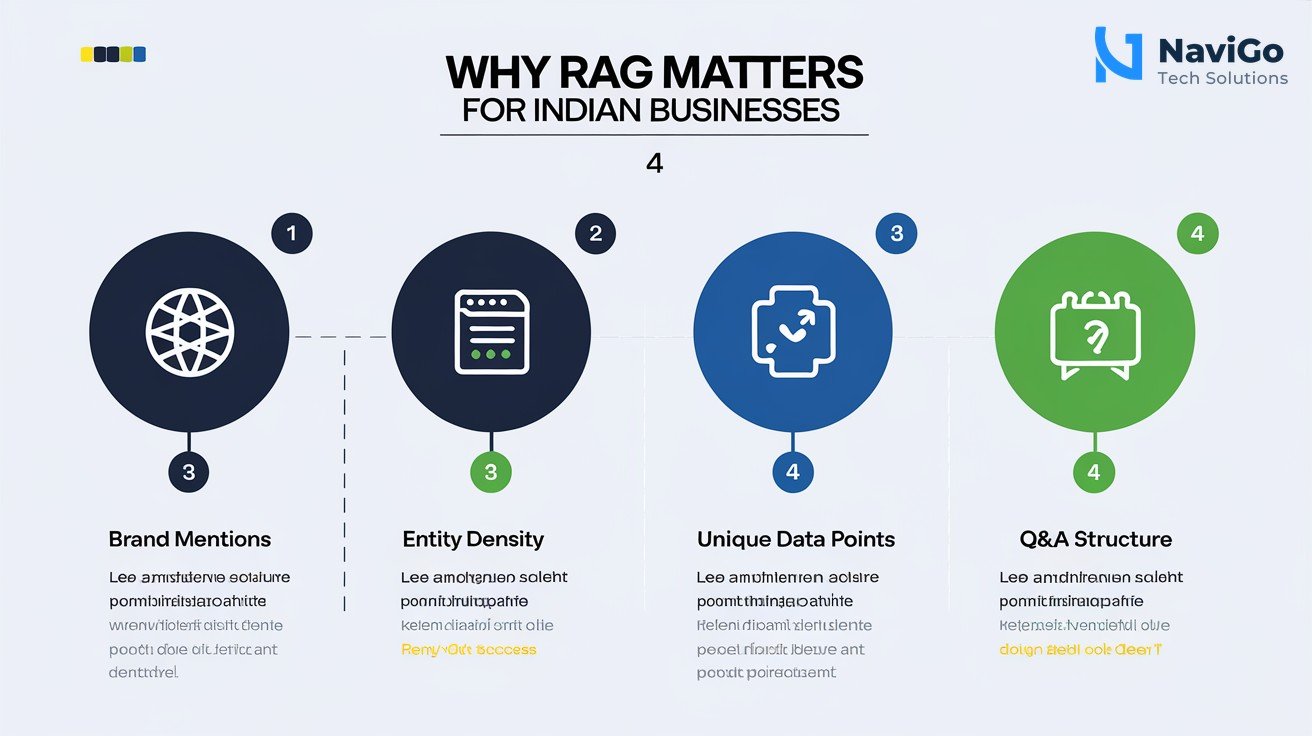
Why should an Indian business owner care? Because every time a potential customer in Chennai asks ChatGPT about the best local restaurant or service provider, RAG decides which brand gets mentioned. If your page is not optimised for retrieval, you stay invisible. On the other hand, pages with high entity density, unique statistics, and clear Q&A structure get cited far more often. Studies show that content structured as a question followed immediately by an answer is cited twice as often as plain paragraphs.
Ahrefs itself has built tools like Brand Radar to monitor how often your brand appears in AI Overviews, ChatGPT, and Perplexity responses. This is the new battleground. You can read more in our Google AI Updates 2026 guide to see how these changes affect search behaviour.
Why RAG Matters for Indian Business Visibility
India has over 600 million internet users, and a growing number of them use ChatGPT, Perplexity, and Google AI Overviews as their first search tool. If your business website does not appear in AI citations, you lose a huge share of voice.
Brand Mentions Beat Backlinks in AI Search
Ahrefs data now shows that brand mentions from authoritative sources rank higher than backlinks or Domain Rating in off-page SEO. For Indian businesses, getting mentioned in news portals, industry publications, and local directories matters more than chasing spammy links. When ChatGPT evaluates your page, it looks for your brand name in the title, meta description, and the first 30% of content. That is where 44.2% of all citations come from.
Entity Density Drives Citations
Content cited most often through RAG contains roughly 20.6% entity density, meaning proper nouns like brand names, cities, person names, and numbers. Average Indian business content sits at 5 to 8%. By simply adding more named entities, your Chennai local service page jumps in visibility. For example, instead of writing “Our agency serves Chennai,” write “NaviGo Tech Solutions serves small businesses in Chennai, T Nagar, and OMR.” That small change doubles your entity density.
Unique Data Points Predict Citations
A study of 150 ranking pages found that the number of unique data points was the biggest predictor of ChatGPT citations. Websites featuring quotes saw a 27.2% uplift, and statistics gave a 25.2% uplift. For an Indian e-commerce store, publishing original survey data about local buying habits can push your page into AI responses. This is a low-cost, high-impact tactic.
To see how entity density works in practice, read our Local SEO Guide Chennai for a step-by-step approach using localised entity strategy.
How to Optimise Your Pages for AI Citations: Step by Step
Follow these numbered steps to make your content RAG-ready for ChatGPT, Perplexity, and Google AI Overviews. Each step is practical and can be implemented by a small business owner or a marketing manager in under a day.
- Step 1: Use the BLUF structure. Bottom Line Up Front. Place your main answer in the first two paragraphs. Studies show that 44.2% of AI citations come from the first 30% of your page. Clearly state what your business offers and who you serve right at the top.
- Step 2: Add a Q&A section for each major topic. Content structured as “Question: How much does a website cost in India?” followed immediately by “Answer: A basic business website costs between Rs 15,000 and Rs 50,000 in 2026.” This format is cited almost twice as often.
- Step 3: Boost your entity density. Include 5 to 10 proper nouns per 100 words. Mention your brand name, locations, partners, product names, and industry terms. For a Chennai bakery, include “Sharma’s Bakery, Velachery, OMR, Adyar, custom cakes, eggless options, gluten-free flour.”
- Step 4: Publish unique data points. Original statistics, quotes from founders, and survey results give you a 30 to 40% visibility uplift. Run a quick Google Form survey among your customers and publish the findings on your website.
- Step 5: Keep your page fast. ChatGPT fetches pages on a hard timeout of around two seconds. If your Time to First Byte exceeds 1 second, your page risks truncation. Use a CDN and minimise heavy scripts. HTTP status code 499 signals a site too slow for AI retrieval.
- Step 6: Ensure your content loads in HTML. AI models struggle with information hidden inside JavaScript. Serve key text in plain HTML so the retrieval engine can chunk it easily.
For more depth on how AI assistants use your content, see our OpenAI GPT 5.6 Automation Guide for Indian SMEs.
Common Mistakes That Block AI Assistants from Citing You
Even after following the steps above, some Indian businesses still do not see AI citations. Here are the mistakes that stop your pages from being retrieved.
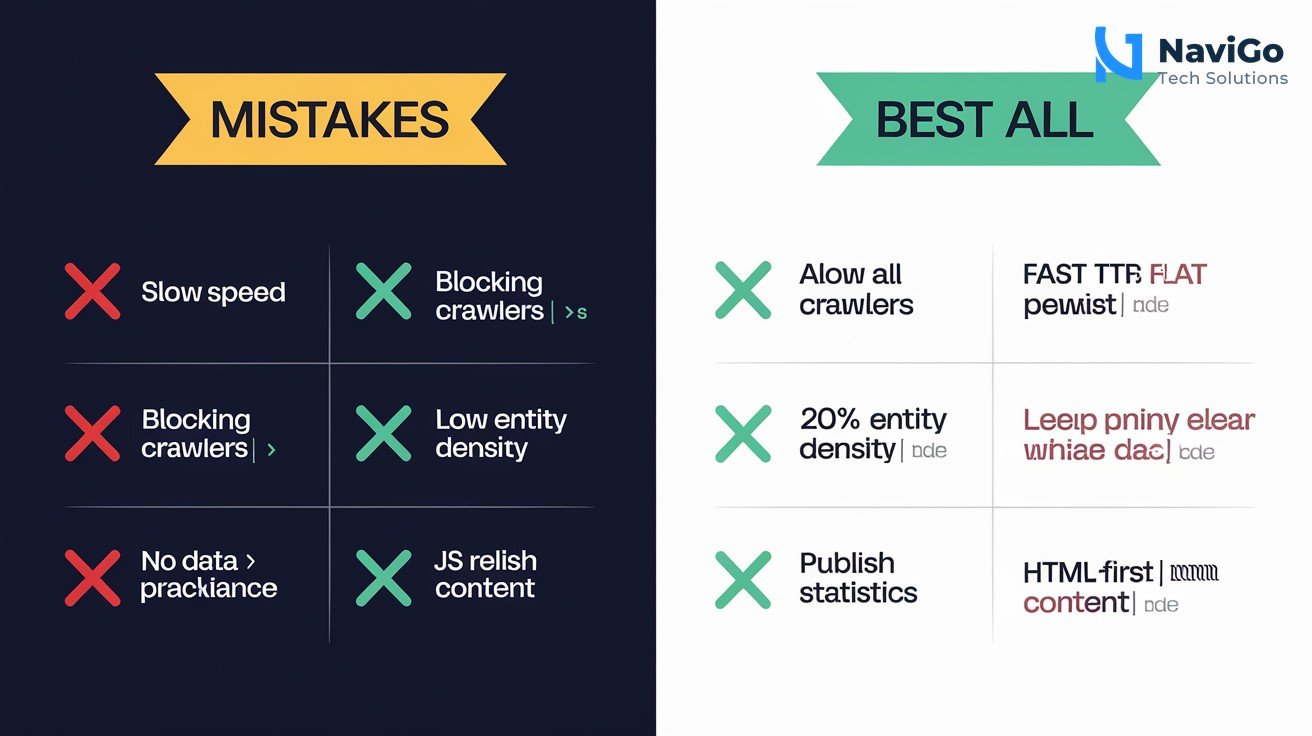
Mistake 1: Slow Page Speed
TTFB over 1 second is a dealbreaker. If your site runs on a slow shared hosting plan in India, upgrade to a cloud server or use a content delivery network. Every millisecond counts because the retrieval engine abandons slow pages.
Mistake 2: Blocking AI Crawlers
Many business owners block bots like OAI_SearchBot or GPTBot in robots.txt thinking it reduces server load. That decision also blocks retrieval. Unless you have strong reasons, allow all relevant AI crawlers.
Mistake 3: Low Entity Density
Writing generic content without specific names reduces your chance of citation. A page that says “best digital marketing company in India” without naming any agencies or locations has low entity density. Instead, name your city, your competitors, and your service areas.
Mistake 4: No Unique Statistics or Quotes
If your page only contains generic advice found on ten other sites, the AI has no reason to pick yours. Publish your own data. For example, “80% of our Chennai clients saw a 40% increase in leads within three months” is a unique data point that drives citations.
Mistake 5: Relying Only on JavaScript for Content
Pages built with React or Angular that load dynamic content via JavaScript may not be seen by AI crawlers. Important information should be present in the initial HTML render.
If you are unsure whether your site is optimised, our SEO Optimization service can audit your pages for AI readiness.
RAG Optimization Checklist vs. Traditional SEO
Traditional SEO focuses on backlinks, keyword density, and meta tags. RAG optimization adds new layers. The table below shows the key differences and what matters for each approach.
| Factor | Traditional SEO | RAG Optimization | Action for Indian Businesses |
|---|---|---|---|
| Keyword focus | High keyword density in content | Entity density and semantic relevance | Use 15-20% proper nouns and named entities |
| Backlinks | High Domain Rating needed | Brand mentions matter more | Get featured in local news and industry portals |
| Content structure | Long paragraphs and subsections | Q&A pairs and BLUF format | Add a FAQ section with question-answer pairs |
| Data requirements | High word count | Unique statistics and quotes | Publish original survey data or customer success numbers |
| Page speed | Under 3 seconds load time | TTFB under 1 second, fetch time under 2 seconds | Use CDN and upgrade hosting |
| Crawler access | Allow Googlebot | Also allow OAI_SearchBot, GPTBot, and PerplexityBot | Check robots.txt and whitelist all bots |
The key takeaway is clear. Traditional SEO is not dead, but RAG optimization is the new priority. By blending both approaches, Indian small businesses can capture citations from ChatGPT, Perplexity, and Google AI Overviews. Start with the steps in section three and watch your brand appear in AI responses. For dedicated help, consider our AI Ads & Automation service to run AI-optimised campaigns that drive visibility.
Not sure which tool fits your business?
Our team at NaviGo Tech Solutions will set it up for you — free 30-minute strategy call.