- How AI chemist platforms reduce drug discovery time from years to months
- Why Indian pharma is in a unique position to lead this transformation
- Practical steps to integrate AI into your R&D and manufacturing workflows
- Budget 2026 policies that support API self-reliance and AI adoption
What Is an AI Chemist and How Does It Work?
An AI chemist is a software system that uses machine learning and generative chemistry to design, test, and optimise new molecules for drug development. Instead of relying solely on human intuition and lab experiments, these platforms can simulate thousands of chemical combinations in minutes.
For example, Insilico Medicine linked their target discovery platform with a generative chemistry AI to find a breakthrough drug candidate for fibrosis. They went from target identification to preclinical candidate in under 18 months, which usually takes 4 to 5 years.
For Indian pharma companies, this means you can now run large-scale virtual experiments without huge lab infrastructure. You can predict how a molecule will behave in the body, check for toxicity, and even suggest manufacturing routes, all before making a single gram in the lab. This is not a futuristic concept. Platforms from companies like Insilico, Atomwise, and Schrdinger are already in use by leading global pharma firms.
In India, where cost efficiency and speed are critical advantages, adopting AI chemistry can help you compete with bigger players. The key is to start with a clear problem, like repurposing an existing drug or designing a new API, and then use AI to accelerate that specific goal.
Why This Breakthrough Matters for Indian Pharma in 2026
India’s Pharma Sector Is Poised for a Leap
According to a BioSpectrum India report from April 2026, AI is now taking the reins in Indian pharma. Companies are investing in AI-driven drug discovery to cut development costs and time. The Indian government’s Budget 2026 also pushes for API self-reliance and export incentives, making it the perfect time to adopt AI chemistry.
API Self-Reliance Is a National Priority
The Economic Times reported in January 2026 that the pharma sector is seeking API self-reliance to reduce dependency on China. AI can design and optimise manufacturing processes for critical APIs, allowing Indian companies to produce them locally at lower cost.
Faster Drug Discovery with Lower Risk
A PwC report from January 2026 highlights that pharma breakthroughs at scale are driven by AI and data analytics. AI can predict which drug candidates will succeed in clinical trials, reducing the 90 percent failure rate that plagues traditional R&D.
Chemistry-Driven Technologies Need Smart Regulation
Chemistry World noted in February 2026 that India must govern emerging chemistry-driven technologies carefully. AI chemist tools can help companies stay compliant by automating documentation and predicting regulatory outcomes.
For example, an Indian API manufacturer could use AI to design a more efficient synthesis route for paracetamol or ibuprofen, cutting production costs by 20 percent. The same technology can also help discover new antibiotics, a field where India has immense potential but limited R&D capacity.
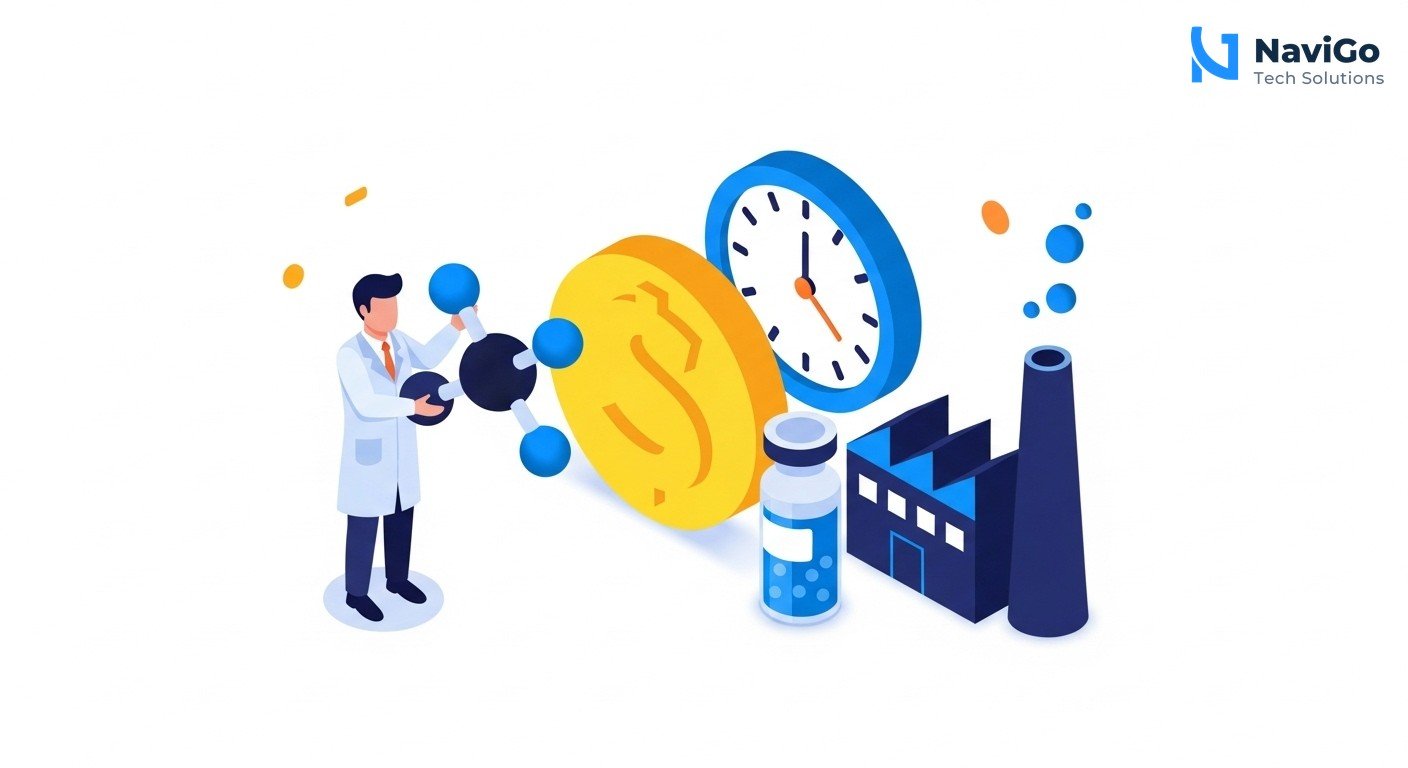
Step-by-Step Guide to Leverage AI Chemistry for Your Pharma Business
- Step 1: Identify a High-Value Use Case. Start with a single problem, such as designing a new generic drug, repurposing an existing molecule, or optimising an API manufacturing route. Focus on a product where even a 10 percent cost saving or time reduction gives you a competitive edge.
- Step 2: Choose an AI Chemistry Platform. Evaluate platforms like Insilico Medicine, Atomwise, or Schrdinger. Most offer free trials or proof-of-concept projects. Pick the one that integrates best with your existing data and workflows. Check their track record with Indian pharma companies.
- Step 3: Prepare Your Data. AI models need high-quality data. Gather your historical chemical synthesis data, clinical trial results, and safety reports. Clean and structure this data in a consistent format. If you do not have enough internal data, consider licensing public databases like ChEMBL or PubChem.
- Step 4: Run a Pilot Project. Run a small pilot for 3 to 6 months. Use AI to design a small library of molecules for one target. Validate the top candidates in your lab. Measure the time and cost savings compared to your traditional approach.
- Step 5: Scale and Integrate. Once the pilot succeeds, expand AI to more projects. Train your team on the platform. Connect AI outputs with your laboratory information management system (LIMS) and manufacturing execution system (MES).
- Step 6: Monitor Regulatory Compliance. Work with your regulatory team to ensure AI-generated data meets CDSCO or USFDA standards. Use AI to generate reports and documentation for submissions.
If you need help marketing your AI-driven pharma products, check out our AI Digital Marketing services to build campaigns that highlight your innovation.
Common Mistakes to Avoid When Implementing AI in Pharma
Mistake 1: Assuming AI Replaces Human Chemists
AI is a tool to augment, not replace your chemists. The best results come from a human-AI partnership where scientists interpret AI outputs and design critical experiments. Avoid treating AI as a black box. Train your team to understand its strengths and limitations.
Mistake 2: Starting Without a Clear Goal
Many companies buy an AI platform without defining what success looks like. You end up with a tool that produces plenty of data but no actionable results. Always start with a specific business objective, like reducing API cost by 15 percent or discovering one new molecule in 12 months.
Mistake 3: Ignoring Data Quality
AI is only as good as your data. If your historical data is inconsistent, missing, or wrong, the AI model will produce misleading results. Invest time in cleaning and standardising your datasets before feeding them into any platform.
Mistake 4: Overlooking Marketing and Digital Presence
Even the best AI-driven drug discovery needs visibility. If you do not rank for keywords like “AI chemist breakthrough” or “pharma innovation India”, your rivals will capture the attention. Our SEO Optimization services can help you rank for these vital terms and attract partners, investors, and customers.
To avoid these pitfalls, consider working with an AI strategy consultant who understands both pharma and technology. A phased approach with clear milestones always works better than a big bang implementation.
AI Chemist Platforms Compared: Tools You Can Use Right Now
Several AI chemist platforms are available for Indian pharma companies. Below is a comparison of the most relevant ones based on cost, features, and India-specific applicability. Choose the one that fits your budget and use case.
| Platform | Best For | Key Feature | Approx. Cost (INR/year) |
|---|---|---|---|
| Insilico Medicine | Target discovery and generative chemistry | End-to-end from target to preclinical | Rs. 1-3 crore |
| Atomwise | Virtual screening of small molecules | AtomNet deep learning engine | Rs. 50 lakh – 1 crore |
| Schrdinger | Molecular modelling and simulations | FEP+ for binding affinity prediction | Rs. 25-50 lakh |
| IBM RXN for Chemistry | Chemical reaction prediction | AI for retrosynthesis and reaction planning | Free basic tier; enterprise custom |
| PostEra | Medicinal chemistry optimisation | Generative chemistry for lead optimisation | Rs. 20-40 lakh |
| BenevolentAI | Drug repurposing and discovery | Knowledge graph and biomedical AI | Custom pricing |
Each platform has its strengths. For example, if you are an Indian generic manufacturer looking to cut API production costs, start with IBM RXN for retrosynthesis. If you want to discover novel molecules, consider Insilico. Our AI Strategy Consulting service can help you evaluate and choose the right platform for your specific business needs.
Not sure which tool fits your business?
Our team at NaviGo Tech Solutions will set it up for you — free 30-minute strategy call.