- Why AWS is betting on Grok despite weak enterprise demand
- How Grok 4.3 pricing works and where it undercuts competitors
- The Mantle inference engine and why it changes your API setup
- Three mistakes Indian firms make when deploying Grok
What Is Grok on AWS Bedrock and Why Should Indian Firms Care?
Grok is the large language model built by Elon Musk’s company xAI. It has been available through X (formerly Twitter) for consumer use since late 2024. Now, with the release of Grok 4.3 on Amazon Bedrock, Indian businesses can access it through AWS just like they access Claude or GPT models.
Amazon Bedrock is a managed service that lets companies use top AI models without running their own infrastructure. By adding Grok, AWS gives you a third major option alongside Anthropic and OpenAI. That matters for Indian firms because more competition means better pricing and more choice for your specific use case.
Grok 4.3 runs on a new inference engine called Mantle. Mantle uses an OpenAI-compatible API endpoint, not the standard Bedrock endpoint. That means if your development team already writes code for OpenAI, you can switch to Grok with minimal changes — just update the endpoint URL and model name.
One important detail: xAI merged into SpaceX in February 2026. The company structure is still evolving. Nine of the original eleven co-founders have left as of late May 2026. That creates some vendor risk you need to factor into your decision. For more on how to evaluate AI vendors, read our guide on AWS ML Agentic Vision: What Indian Firms Must Know.
Why Grok 4.3 Matters for Indian Enterprises Right Now
Cost Advantage: 5x Cheaper Than Claude Sonnet 4.6
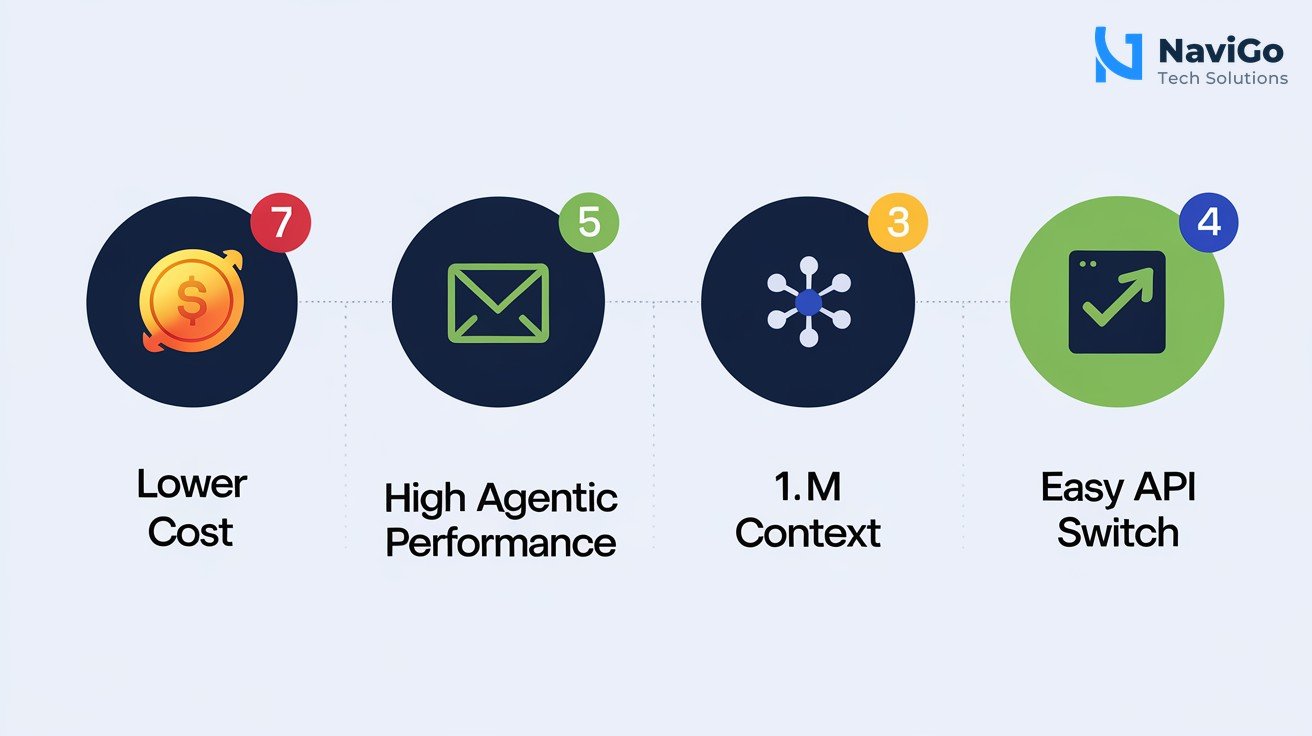
Bindu Reddy, CEO of Abacus AI, described Grok 4.3 as being as smart as Sonnet 4.6 but 5x cheaper and faster. At $1.25 per million input tokens and $2.50 per million output tokens, Grok beats almost every frontier model on price. For Indian startups and SMEs running high-volume agentic workloads, that difference shows up directly in your monthly AWS bill.
Agentic Performance: Best in Class for Structured Tasks
Grok 4.3 scores 1,500 on the GDPval-AA agentic ELO benchmark — a massive jump from its predecessor. It ranks number one on Vals AI CaseLaw v2 with 79.3 percent accuracy and number one on Vals AI CorpFin. Its score on Tau2-Bench Telecom hit 98 percent. If your business builds AI agents for customer support, financial document Q&A, or legal research, Grok is a strong candidate.
1 Million Token Context Window
With a context window of 1 million tokens, Grok can handle very large documents — think annual reports, legal contracts, or entire product catalogs. The catch is that pricing doubles for any request over 200,000 total tokens. You need to plan your prompts wisely.
OpenAI-Compatible API via Mantle
Mantle launched OpenAI-compatible support in March 2026. That means you can call Grok using the same openai Python SDK you already use for GPT models. No need to learn a new API. Your team can start testing within hours, not days.
If you want to understand how AI agents can automate your customer service workflows, check out our post on Google Gemini Agents to Automate Your Indian Business: 2026 Guide.
How to Get Grok Running on AWS Bedrock for Your Business
Step 1: Ensure Your AWS Region Supports Grok
Grok 4.3 is available in three US regions only: Oregon (us-west-2), N. Virginia (us-east-1), and Ohio (us-east-2). There is no support for cross-region inference or multi-region failover at launch. Indian firms should pick the closest region (us-east-1) for lowest latency.
Step 2: Switch to the Mantle Endpoint
Grok does not work with the standard Bedrock InvokeModel or Converse API. You must use the Mantle endpoint: https://bedrock-mantle.{region}.api.aws/openai/v1. Replace {region} with your chosen AWS region.
Step 3: Use an OpenAI-Compatible Client
Install the openai Python SDK. Configure your client with the Mantle endpoint URL and your AWS credentials (which must have Bedrock access). The model ID is xai.grok-4.3.
Step 4: Set Reasoning Effort
Grok 4.3 always uses reasoning by default. You can control it via the reasoning.effort parameter — set it to none, low, medium, or high. For simple Q&A, set it low to save cost. For complex agentic tasks, set it high.
Step 5: Monitor Token Usage
Pricing doubles for any request over 200,000 total tokens within the context window. Use prompt compression or chunking for long documents. Cache frequent inputs to get the cached input rate of $0.20 per million tokens.
Common Mistakes Indian Firms Make with Grok on Bedrock
Mistake 1: Ignoring the Hallucination Trade-Off
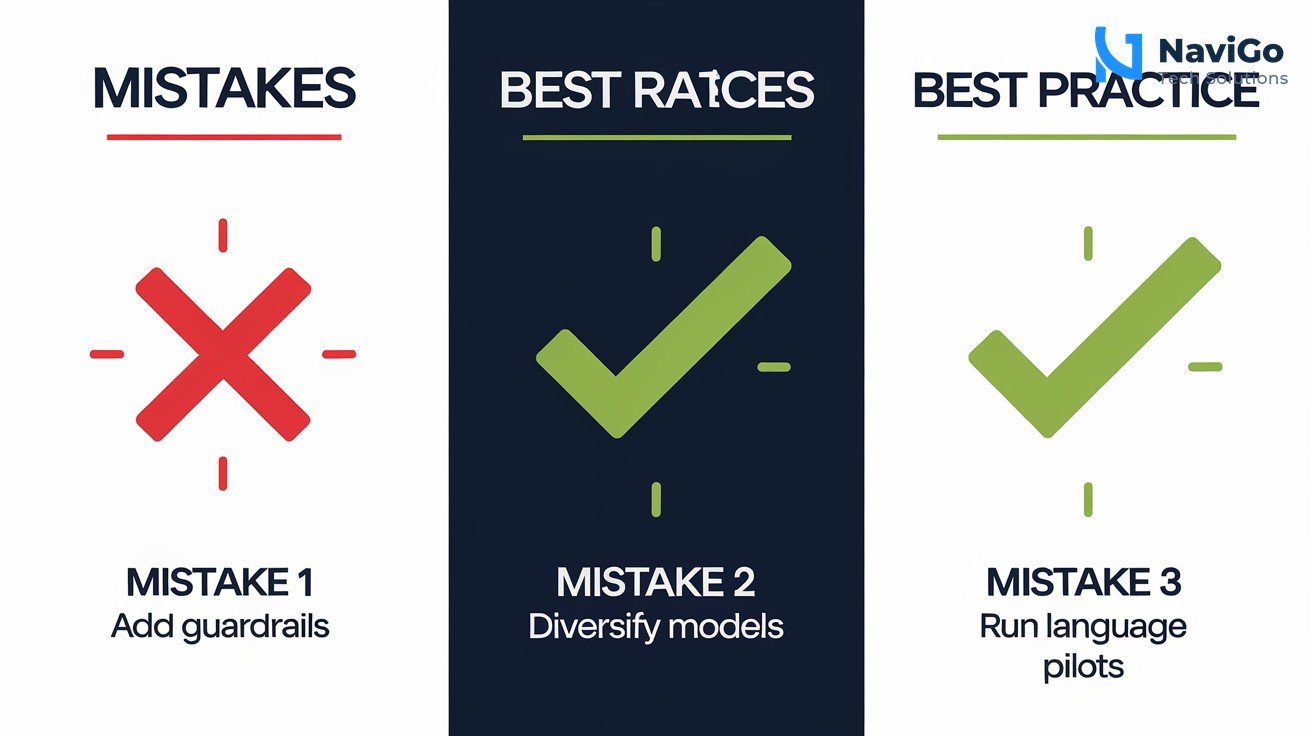
Grok 4.3 lost about 8 points on the non-hallucination metric compared to Grok 4.20, while gaining 8 points on factual accuracy. That means it gives more correct answers but also more confident wrong ones. For regulated industries like finance and healthcare in India, this is a real problem. Always add guardrails and human review loops. Consider our AI strategy consulting to build safe AI workflows.
Mistake 2: Overlooking Vendor Instability
xAI merged into SpaceX and lost most of its original team. The company’s long-term roadmap is unclear. If you build your entire AI stack on Grok today, a sudden deprecation or price change could disrupt your operations. Hedge your risk by using Bedrock’s multi-model support.
Mistake 3: Not Testing with Indian Language Data
Grok 4.3 processes text and images but outputs text only. Its training data may have limited representation of Indian languages. Run pilot tests on Hindi, Tamil, or Bengali customer queries before scaling production.
Grok 4.3 vs Claude Sonnet 4.6 vs GPT-5.6: Quick Comparison
If you are evaluating AI models for your Indian business, here is a side-by-side comparison of the three leading options on AWS Bedrock. All data as of June 2026.
| Feature | Grok 4.3 | Claude Sonnet 4.6 | GPT-5.6 Sol Terra Luna |
|---|---|---|---|
| Pricing (input) | $1.25/M tokens | $3.00/M tokens | $2.50/M tokens |
| Pricing (output) | $2.50/M tokens | $15.00/M tokens | $10.00/M tokens |
| Context window | 1M tokens | 200K tokens | 1M tokens |
| Agentic ELO | 1,500 | 1,420 | 1,480 |
| API Compatibility | OpenAI (Mantle) | Bedrock native | Bedrock native |
| Vendor risk | High (xAI restructuring) | Low (Anthropic stable) | Medium (OpenAI fast-moving) |
If you want to explore GPT-5.6 on Bedrock, read our detailed guide on OpenAI GPT-5.6 Sol Terra Luna Launched on AWS Bedrock.
Not sure which tool fits your business?
Our team at NaviGo Tech Solutions will set it up for you — free 30-minute strategy call.